
Table of Contents
If you work along the Old Mahabalipuram Road (OMR) in Chennai, your day is likely a whirlwind of back-to-back meetings, tight code releases, and long commutes through Navalur or Sholinganallur. Between the glowing screens and ergonomic chairs that never quite feel right, the physical and mental toll of “desk life” is real.
Many IT professionals in OMR struggle with chronic neck tension, lower back stiffness, and that familiar mid-afternoon mental fog. It is easy to think that a weekend gym session is enough to undo 50 hours of sitting, but your body requires more consistent, mindful intervention.
Yoga for office professionals in OMR Chennai is more than just a fitness trend; it is a strategic tool for survival in a high-pressure environment. By integrating specific movements and breathwork into your day, you can transform your relationship with your workspace, turning a source of stress into a space of sustained productivity and health.
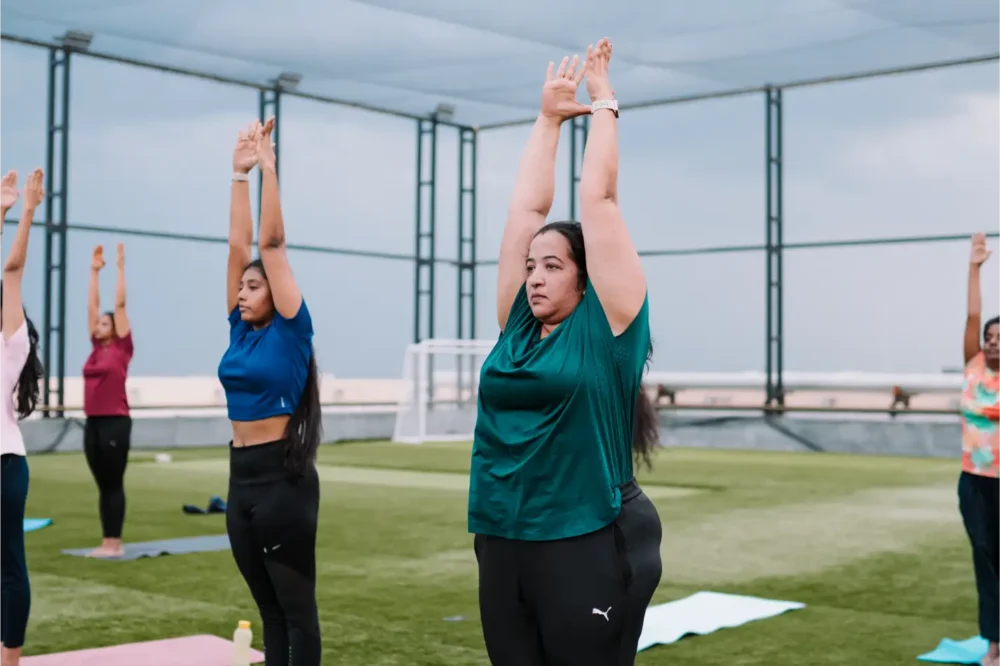
Yoga for office professionals is a targeted practice designed to counteract the physiological and psychological effects of prolonged sitting and high-stress cognitive work. It focuses on opening the chest, mobilizing the spine, releasing hip flexors, and using “micro-meditations” to reset the nervous system during the workday.
In the OMR ecosystem, “time is money.” However, neglecting your physical health leads to a different kind of cost: burnout, repetitive strain injuries, and decreased focus. When you sit for eight hours, your hip flexors shorten, your glutes “turn off,” and your upper back rounds—a phenomenon often called “Tech Neck.”
This isn’t just about posture; it’s about energy. A stagnant body leads to a stagnant mind. Yoga helps circulate blood flow to the brain, flushes out metabolic waste from the muscles, and regulates the sympathetic nervous system, which is often stuck in “fight or flight” mode due to project deadlines.
For the busy OMR professional, yoga works by focusing on three essential shifts that can be practiced even in a cubicle:
Most office-related pain stems from a sedentary spine. Yoga introduces movements like “Seated Cat-Cow” or “Lateral Stretches” to move the vertebrae in all six directions, ensuring the spinal discs remain hydrated and healthy.
When we are stressed, our breath becomes shallow and rapid. Techniques like Box Breathing or Nadi Shodhana (Alternate Nostril Breathing) can be done at your desk in two minutes to instantly lower heart rate and clear mental clutter.
Specifically for those in software and data roles, yoga includes Trataka (eye exercises) and wrist stretches to prevent Carpal Tunnel Syndrome and digital eye strain, addressing the “hidden” injuries of the IT world.
Regular practice strengthens the core muscles that support your posture, meaning you’ll find yourself sitting taller and experiencing less “Friday afternoon” backache.
By oxygenating the blood, yoga improves cognitive function. Many professionals find that a 10-minute yoga break helps them solve complex bugs or strategy hurdles faster than a third cup of coffee.
The IT corridor can be a high-friction environment. Yoga teaches you to observe your stress triggers without reacting impulsively, leading to better team dynamics and a calmer commute.
If you have never tried yoga, OMR is actually a great place to start. You don’t need to be flexible to begin; you just need to be willing to move.
- Start Small: Don’t aim for a 90-minute class immediately. Begin with 5-minute “desk breaks” every two hours.
- Use Your Commute: If you are stuck in OMR traffic in a cab or bus, use that time for neck isometrics and deep belly breathing.
- Join a Corporate Group: Many IT parks in Taramani and Siruseri now offer in-house wellness sessions. Look for “Beginner Hatha” or “Restorative” classes.
- “I don’t have time”: Yoga isn’t an “all or nothing” practice. A two-minute stretch is better than zero minutes.
- “I’m too stiff”: Stiff people are exactly who yoga was made for. It is a process of opening up, not a showcase for the already flexible.
- “It’s too spiritual”: While yoga has deep roots, modern corporate yoga is often purely functional, focusing on anatomy, physiology, and stress management.
- Set a “Movement Alarm”: Use a browser extension or phone alert to stand up every 50 minutes.
- Hydrate with Intent: Every time you take a sip of water, take one deep, conscious breath.
- The “Doorway Stretch”: Every time you walk through a door at your office, place your arms on the frame and lean forward to open your chest and counteract slouching.
- Practice “Belly Breathing” during Calls: If you are on a listen-only Zoom call, focus on expanding your abdomen as you inhale to calm your nervous system.
Arjun, a 34-year-old software architect in Navalur, suffered from severe migraines and lower back pain. He started a 15-minute morning routine and “desk-yoga” twists every afternoon. Within three weeks, his migraine frequency dropped by 50%, and he felt more “present” during his team stand-ups.
Priya, working in a bustling IT park in Perungudi, felt overwhelmed by constant recruitment deadlines. She joined a local weekend outdoor yoga session in Besant Nagar to decompress. The combination of salt air and stretching helped her manage her anxiety and gave her a “mental reset” that made her more effective during the work week.
1. Can I do yoga in my office clothes? Yes! Many desk yoga poses, such as seated twists, neck releases, and wrist stretches, are designed to be done in formal or semi-formal attire without breaking a sweat.
2. Is there any specific yoga for back pain caused by sitting? “Bhujangasana” (Cobra Pose) and “Adho Mukha Svanasana” (Downward Dog) are excellent for reversing the slouch. At your desk, a simple seated forward fold can provide immediate relief.
3. I work night shifts in OMR. When should I practice? Practice “Sun Salutations” when you wake up to signal to your body that your “day” has begun. Before your shift ends, practice cooling “Moon Salutations” or deep breathing to help you sleep during daylight hours.
4. How can yoga help with eye strain from coding? Yoga includes “eye palming”—rubbing your hands together to create heat and placing them over your closed eyes. This relaxes the optic nerve and relieves digital fatigue.
5. Are there yoga centers near OMR that cater to IT timings? Many centers in Thiruvanmiyur and Adyar offer early morning (6:00 AM) and late evening (7:30 PM) classes specifically for the IT crowd.
6. Does yoga help with the stress of a long OMR commute? Absolutely. Deep breathing while stuck in traffic reduces the production of stress hormones like cortisol, preventing “commuter rage” and exhaustion.
Your career in Chennai’s IT corridor is a marathon, not a sprint. By integrating yoga into your life, you are choosing to prioritize the very engine that drives your success: your body and mind.
Whether it’s a quick stretch between sprints or a sunrise session on the beach, every bit of movement counts. Take a deep breath, roll your shoulders back, and remember that your wellness is your greatest professional asset.
Ready to reclaim your energy? Start with one conscious breath today. If you’re looking for guided support, reach out to explore how specialized sessions can fit into your OMR lifestyle.
